NIMASA Opens Applications for Seafarer Training and Certification Programmes
The Nigerian Maritime Administration and Safety Agency (NIMASA) has introduced new regulatory requirements that could significantly reshape career development, professional certification and employment opportunities in Nigeria’s maritime sector.
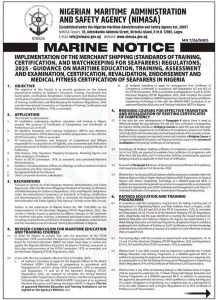
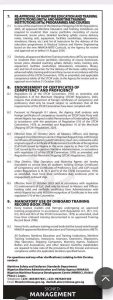
The new requirements are contained in Marine Notice MN 7/26/SN05, issued by NIMASA on the implementation of the Merchant Shipping (Standards of Training, Certification and Watchkeeping for Seafarers) Regulations, 2025.
The notice provides updated guidelines for maritime education, professional training, examinations, certification, revalidation and competency development for Nigerians seeking to build careers as seafarers.
Under the new framework, candidates seeking to become officers and other certified maritime professionals will be required to undergo training based on the revised Nigerian Maritime Education curriculum developed in line with international STCW standards.
For Nigerians interested in maritime careers, shipboard employment and professional advancement, the changes are particularly important because possession of the appropriate Certificate of Competency (CoC) or Certificate of Proficiency (CoP) is a key requirement for working in regulated seafaring positions.
NIMASA said candidates intending to obtain the Nigerian Officer of the Watch (OOW) Certificate of Competency (Unlimited) are required to complete the revised National Diploma (ND) and Higher National Diploma (HND) programmes in Nautical Science or Marine Engineering Technology at NIMASA-approved Maritime Education and Training Institutions.
The agency has also introduced bridging courses for existing certificate holders, allowing qualified seafarers to update their competencies and remain eligible for professional engagement under the revised standards.
Seafarers whose Certificates of Competency were issued on or before July 3, 2026, are required to revalidate their certificates by completing approved bridging courses, with the process to be completed on or before December 31, 2028.
NIMASA further announced a new 15-week Ratings Education and Training Programme for candidates seeking to obtain Certificates of Proficiency as ratings.
The programme is designed to equip trainees with the knowledge and practical competence required to work onboard ships at support level.
From July 3, 2026, candidates undergoing the ratings programme will also be required to obtain approved and documented sea service on a seagoing ship before sitting for the relevant Certificate of Proficiency examinations.
Those seeking certification as Able Seafarer Deck or Able Seafarer Engine will equally be required to complete a 15-week Advanced Ratings Education and Training Programme at a NIMASA-approved institution, alongside the required sea-service experience.
The development is expected to make professional training and certification increasingly important for Nigerians seeking employment opportunities onboard commercial vessels and other maritime operations.
NIMASA’s notice does not constitute a recruitment announcement or advertise specific job vacancies. Rather, it establishes the qualifications, training and certification requirements that prospective and existing seafarers must meet to remain eligible for regulated maritime employment.
The agency has also directed approved Maritime Education and Training Institutions and Maritime Training Institutions to undergo re-approval under the new regulatory framework.
Approved METIs are expected to submit their course portfolios and relevant training documentation to NIMASA for review and approval on or before August 31, 2026, while approved MTIs are required to submit their documentation on or before October 31, 2026.
For prospective maritime workers, the new framework therefore places greater emphasis on attending NIMASA-approved institutions, obtaining recognised certificates, completing required sea-service periods and keeping proper training records.
NIMASA has also made the use of Onboard Training Record Books (TRBs) mandatory for trainees, including cadets and ratings. The agency said seafarers’ training record books will henceforth be issued only through NIMASA-approved Maritime Education and Training Institutions.
The new rules are expected to affect both new entrants seeking to establish careers in the maritime industry and existing seafarers seeking career progression, certification renewal and continued employment.
For anyone looking to enter the Nigerian maritime industry, the key takeaway is that the new NIMASA framework makes recognised training, certification and documented sea experience central to securing and maintaining professional opportunities in the sector.